Following a request from Ms Kučuk – Sorguč, the Institute for the Protection of Monuments inspected the existing condition and provided guidelines for conservation and restoration works on the external joinery/windows of the Museum of Jews in Sarajevo.
“Historic Building – the Old Jewish Temple (Il Kal Grandi – the Great Temple, or Il Kal Vježu – the Old Temple or the Old Synagogue) in Sarajevo”, a national monument of Bosnia and Herzegovina (Decision No. 06-6-977/03-3, 7 October 2003)
In the Decision in question, the Commission, with the aim of ensuring the lasting protection of the national monument, defined protection measures permitting research and conservation and restoration works:“Works relating to conservation, restoration and adaptation may be carried out on the building and in the courtyard, whereby it is mandatory to retain and reconstruct the original form of the building and all its elements on the basis of which the original purpose of the building is discernible; the original form and purpose of the building and their changes must be presented appropriately as part of the whole.”
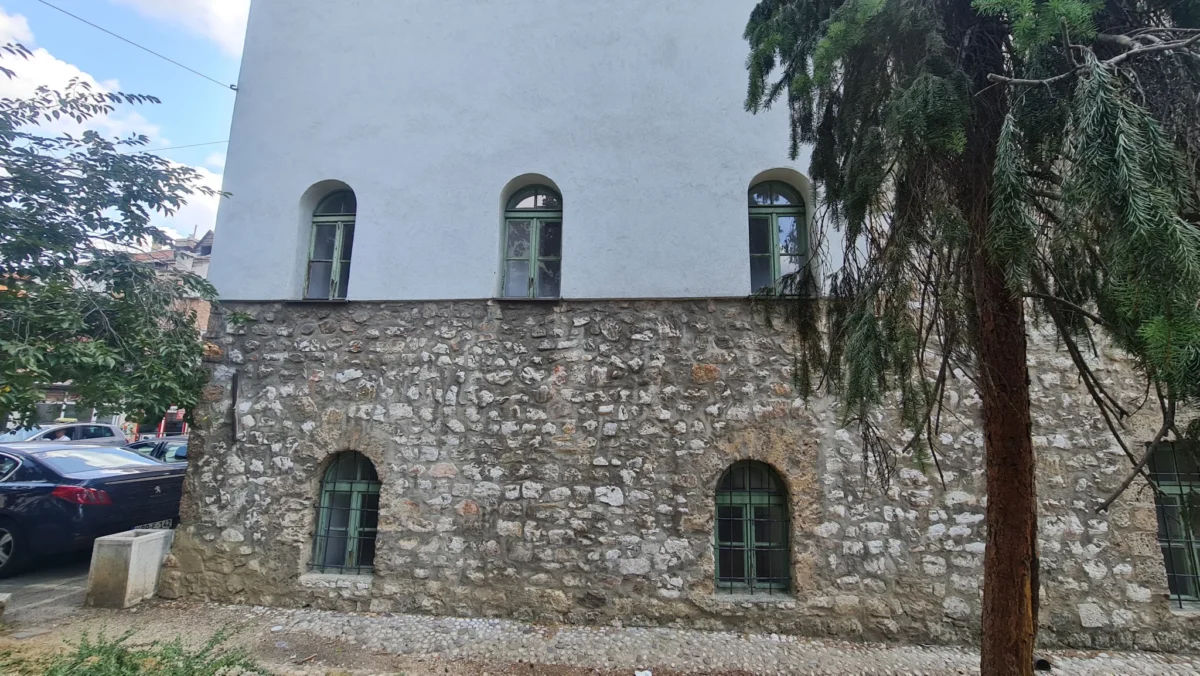
A visual inspection of the external joinery/windows established that the joinery is in relatively good condition. The current condition of the external joinery/windows is characterised by varying degrees of damage or deficiencies, including damage to individual window elements, a missing opening handle, broken glass, missing pointing in the stone around the windows and similar issues. The access sequence/park landscaping on the western side of the Museum is in a poorly maintained condition, with various types of waste, poorly maintained paving, street furniture and horticultural elements.
The northern entrance is used as the official entrance for staff, while the area between the northern side of the buildings and Maršala Tita Street is used as staff parking. The access step at the existing main entrance to the courtyard, made of stone cobbles, is partially damaged: in one section there is a concrete base and in another cobbles, posing a danger to visitors. All existing entrance doors must be cleaned of dirt and adhesive strips using standard cleaning methods, after which an assessment must be carried out to determine whether conservation and restoration intervention is required. The cobbled paving in the building’s courtyard is partially damaged, mainly due to the loss of jointing material, and conservation and restoration works must be undertaken. The existing ticket office, a heated space accommodating three staff members, is an inadequate solution both in terms of the functions accommodated in an area of approximately 4 m² and the employees’ working conditions. The existing toilet, used by both staff and visitors, is not adequately equipped.
Damp was recorded on the western stone wall of the building’s ground-floor interior. It was subsequently established that the vertical downpipe on the western wall discharges into a stone-cobble drainage channel containing waste and soil. The external and internal doors of the vestibule are modern and require cleaning and conservation. The space to the right of the entrance is used as an improvised VR room and storage area for various museum materials. On the first and second floors, the railing in the gallery area does not comply with architectural standards and poses a danger to visitors. It is impossible to ventilate the second-floor space, making occupancy uncomfortable and difficult. Following its inspection of the existing condition, the Institute issued instructions and guidelines for conservation and restoration works on the external joinery/windows and metal grilles, and for the installation of insect screens in the anteroom on the second floor to enable ventilation. The rehabilitation of the northern entrance, the access step and the existing main entrance to the courtyard, as well as the cobbled paving, was also proposed. The entrance doors must be cleaned of dirt and adhesive strips using standard cleaning methods, after which an assessment must be carried out to determine whether conservation and restoration intervention is required.
The Institute suggested how the entrance area could be adapted in order to provide an adequate workspace for the ticket office and souvenir shop. From the perspective of visitor safety, it was suggested that the railings on the galleries be redesigned in order to meet architectural standards and ensure the safe movement of visitors.