Bisera Alikadić always belonged to another, rare kind, one whose voice remains within us long after we close the final page. Her literary voice did not seek permission to be itself. It came from the depths of experience, from the need to give voice to what had long remained unspoken, particularly when it came to women’s experience, love, the body, loneliness, freedom and the right to one’s own voice.
Her literary oeuvre testifies to a rare creative breadth. Following her first collection of poetry, “Noći i ćilibara”, came the collections “Kapi i mahovina”, “Drhtaj vučice”, “Raspeće”, “Pjesme”, “Dok jesam Ciganka”, “Ne predajem se”, “Grad hrabrosti”, “Knjiga vremena” and “Ludi kamen”. She also wrote numerous books for children: “Kraljica iz dvorišta”, “Tačkasti padobran”, “Pjesmice ljestvice” and “Voz do neba”, thereby succeeding in bringing together the adult world and the world of children, the seriousness of life experience and the playfulness of a child’s imagination.
Through her writing and her “letter”, Bisera Alikadić shifted the boundaries of what was expected and opened up space for heroines who refused to agree to be merely someone’s daughters, wives, mothers or silent companions. Her women feel deeply, make mistakes, desire, suffer, resist and search for themselves. That is precisely why her literature still feels immediate and alive today.
Bisera Alikadić’s sensitivity lies not only in the themes she chose, but also in the way she transformed them into literature. In her language, tenderness and irony, the lyrical and the direct, the intimate and the social meet. She knew how to turn everyday life into a literary space in which we recognise ourselves, and personal experience into a question that belongs to us all.
Bisera Alikadić’s distinctive giggle is a mark of the liberation of literary language from imposed boundaries and testimony to the fact that literature can be at once intimate and rebellious, tender and uncompromising.
Dear Bisera, thank you for the courage to speak in your own voice, thank you for the heroines who refused to accept prescribed roles, thank you for freedom and for delighting in that freedom, thank You for the laughter!
When Women Laugh
As though they had forgotten all their duties, all their woes.
They laugh uncontrollably at themselves, at men,
At children, at nappies,
At the sun, at the catchphrase of their dear departed.
Their laughter is a torrent, a surge of freedom.
A radiant garden in the heart of the universe.
Nothing can compare with this primal joy
Not even a herd of young horses tossing their manes.
Their breasts spill out in every direction.
Flocks of teeth flash, then vanish like birds.
If they placed a lever beneath the Earth
They would roll it along like a heavy ball.
Oh, the joy, when they laugh. As though the sea were surging in,
As though the heavenly horizons were widening.
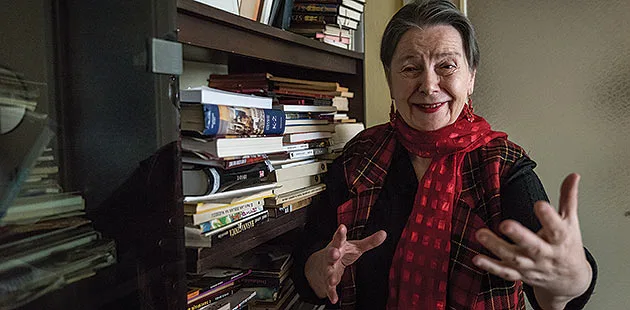
Photograph taken from the website www.biserje.ba.


