
A Homage to the Writer Bisera Alikadić (1939-2026)
Bisera Alikadić always belonged to a rare and singular kind, one whose voice remains with us long after we have closed the final page. Her literary voice never sought permission to be itself. It arose from the depth of lived experience, from the need to articulate what had long remained unspoken, especially when it came to women’s experiences, love, the body, solitude, freedom, and the right to speak in one’s own voice.
Her literary oeuvre bears witness to a remarkable creative breadth. Following her first poetry collection, Nights and Amber, came Drops and Moss, The She-Wolf’s Tremor, Crucifixion, Poems, While I Am a Gypsy Woman, I Do Not Surrender, The City of Courage, The Book of Time, and The Mad Stone. She also wrote numerous books for children, including The Queen from the Courtyard, The Spotted Parachute, Ladder Poems, and The Train to Heaven, thus creating a bridge between the world of adults and the world of children, between the gravity of life experience and the playful imagination of childhood.
Through her writing and her distinctive literary expression, Bisera Alikadić pushed beyond the boundaries of expectation and created space for heroines who refused to exist merely as someone’s daughters, wives, mothers, or silent companions. Her women feel deeply, make mistakes, desire, suffer, resist, and search for themselves. That is precisely why her literature still feels immediate and alive today.
The sensitivity of Bisera Alikadić’s work lies not only in the themes she chose, but also in the way she transformed them into literature. Within her language, tenderness meets irony, the lyrical intertwines with the direct, and the intimate encounters the social. She possessed the rare gift of turning everyday life into a literary space in which we recognize ourselves, and of transforming personal experience into a question that belongs to all of us.
Bisera Alikadić’s unmistakable laughter remains a symbol of the liberation of literary language from imposed boundaries, and a testament to the fact that literature can be, at once, intimate and rebellious, gentle and uncompromising.
Dear Bisera,
Thank you for the courage to speak in your own voice. Thank you for the heroines who refused predetermined roles. Thank you for freedom, and for the joy of living within that freedom.
And thank you for the laugh!
When Women Laugh
As though they had forgotten every duty, every sorrow.
They laugh without restraint at themselves, at men,
At children, at diapers,
At the sun, at a beloved saying of a dear departed friend.
Their laughter is a torrent, a surge of freedom.
A radiant garden in the heart of the universe.
Nothing equals this primordial joy,
Not even a herd of young horses tossing their manes.
Their breasts sway in every direction.
Flocks of teeth flash, then vanish like birds.
Were they to place a lever beneath the Earth,
They would roll it over like a heavy ball.
Oh, the happiness when they laugh.
As though the sea were rushing in,
As though the horizons of heaven were widening.
(courtesy translation)
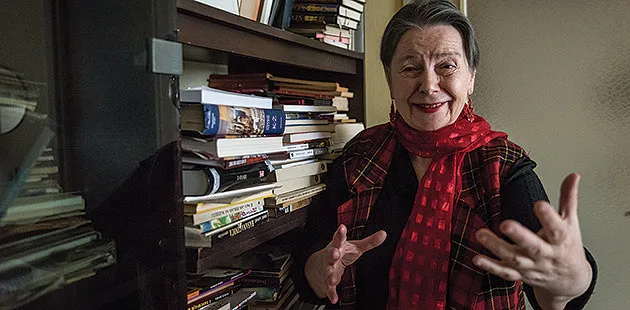
Photo taken from www.biserje.ba.