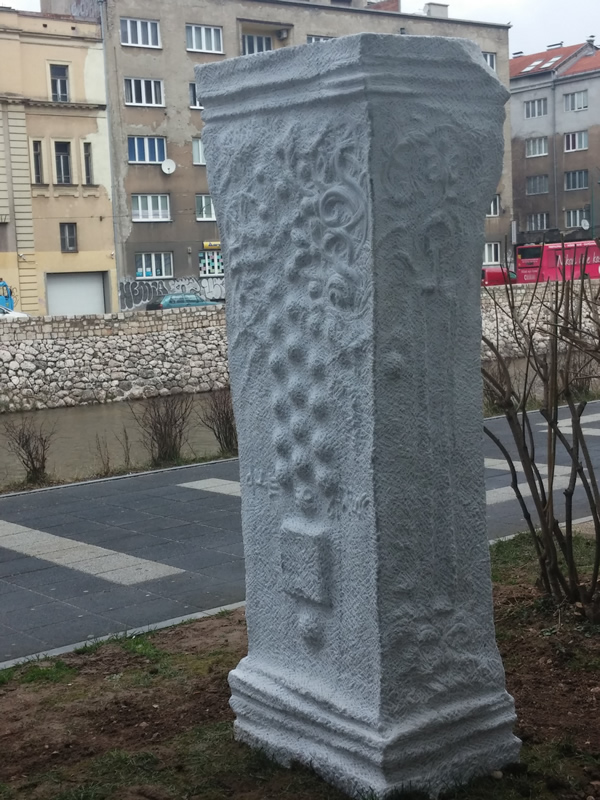
On 19 March 2015, a contemporary sculpture in the form of a stećak, created by the esteemed Bosnian and Herzegovinian artist Adis Fejzić, was installed in Sarajevo on Obala Maka Dizdara.
The Foundation for Music, Performing and Visual Arts purchased the sculpture in question, which forms part of Fejzić’s body of work on stećci and aims to connect Bosnia and Herzegovina’s past and future through historical and artistic symbols.
At the author’s proposal, and with the approval of the Foundation and the Federal Ministry of Culture and Sport, it was decided that the appropriate location for the “Wi-Fi Architrave” sculpture would be Obala Maka Dizdara.
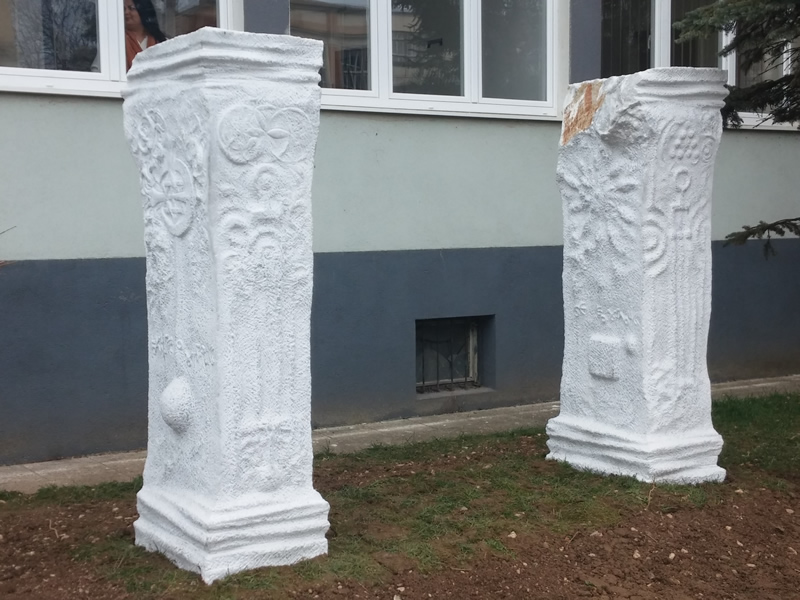
The sculpture is essentially a diptych, measuring 2 x (200x50x70), and is called the “Wi-Fi Architrave”; the absence of an architrave and the existence of an “invisible” connection point to the human need for communication, as well as society’s need to establish a dialogue with its past and future. The sculpture bears symbols on all four sides: an anthropomorphic niche – a symbol of the soul; the Seal of Abraham; the Tree of Life; and a cross-section of human DNA whose shape evokes the sun and the heart, accompanied by verses by Goethe (about the heart) and Mak Dizdar (about the sun), inscribed in Bosančica. There is also a contemporary motif in the form of a phone screen, bearing a different meaningful message on each side: Be to unlock, Feel to unlock, Think to unlock and Act to unlock.
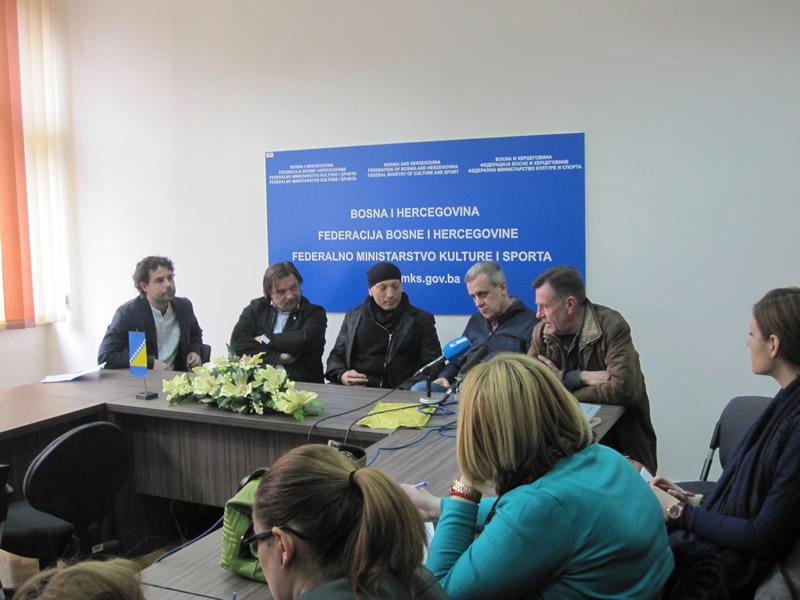
At the press conference held on the occasion of the ceremonial presentation of the sculpture, the speakers were Jasmin Duraković, Chair of the Management Board of the Foundation for Music, Performing and Visual Arts; Professors Dubravko Lovrenović and Besim Spahić; Gorčin Dizdar; and the author, Adis Fejzić. Professor Lovrenović emphasised that stećci are the “most Bosnian” of all Bosnian phenomena, while Professor Spahić warned that works such as this create an opportunity to bridge the cultural and communicative divide in this region. Gorčin Dizdar, President of the Mak Dizdar Foundation, described the “Wi-Fi Architrave” as a work that “transforms medieval heritage through layers of contemporaneity”.
The “Wi-Fi Architrave” installation is also one of the best examples of the practice of the Foundation for Music, Performing and Visual Arts and confirms the importance of its work.