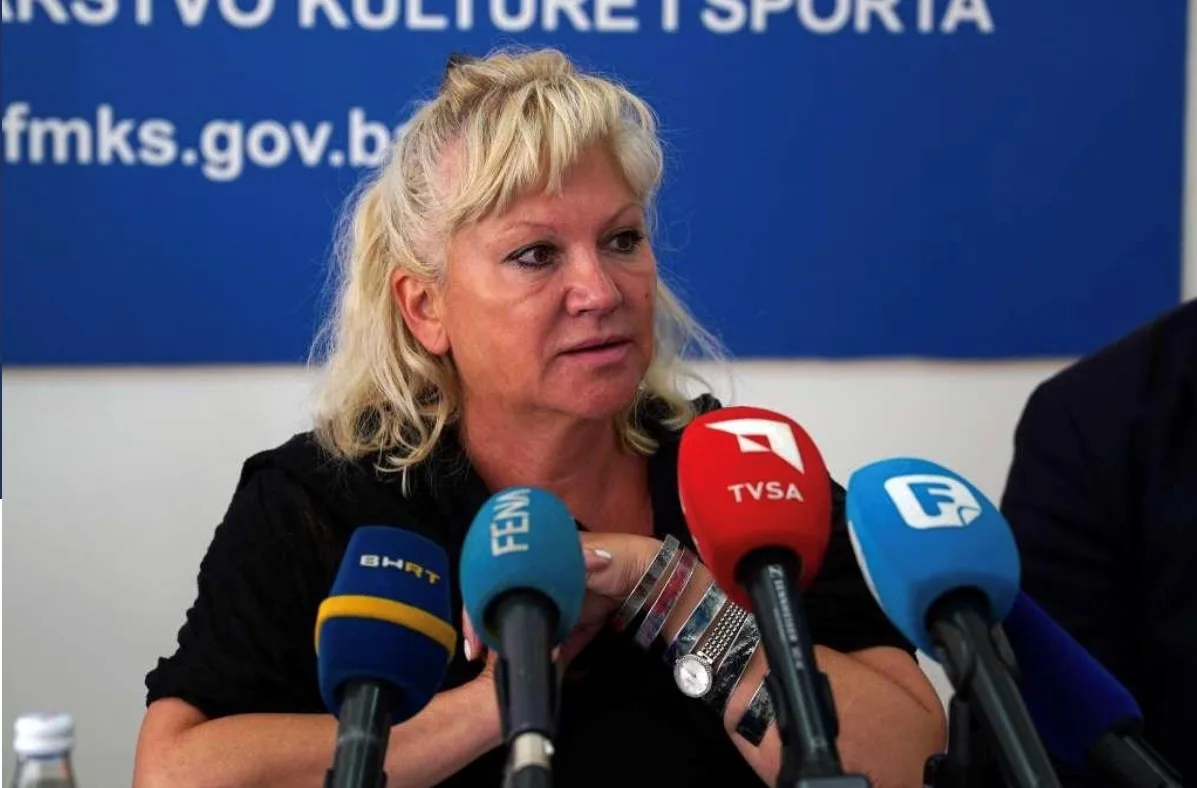
A press conference was held at the Federal Ministry of Culture and Sport on 7 August 2024, addressing numerous topics in the fields of Culture, Sport and Youth.
Thanking the many journalists for attending, as well as for their exceptionally professional and fair reporting on the Ministry’s work over the past period, Minister Sanja Vlaisavljević reflected on the current positive stories that Bosnia and Herzegovina can take pride in:
“Speaking about Culture, we have many topics here. Some of them have been in the public spotlight for quite some time. Let us begin with one positive story that is happening to us. Namely, Sarajevo’s Baščaršija has been declared the new Treasure of European Film Culture, thereby placing Bosnia and Herzegovina on the map of the most important film locations in Europe, while the plaque will be unveiled on 18 August 2024. On behalf of the Federal Ministry of Culture and Sport, I extend my sincere congratulations to Melina Alagić and her team at the Association of Film Workers, because Baščaršija was included on the selected list thanks to the enthusiasm and efforts of this small team, and we can all be proud,” the Minister said.
“What follows is another positive story, namely the 30th anniversary Sarajevo Film Festival. On behalf of the Ministry, I would like to congratulate the Festival’s founder, Miro Purivatra, and his small team. It was a time when few people believed that a small Sarajevo story could become a story that brought Europe and the world together. I would also like to congratulate the new team working on the Festival, Jovan Marjanović and his team, on their perseverance and enthusiasm. I believe that we are all looking forward to and eagerly awaiting the beginning of the 30th anniversary edition, and as a Ministry we will endeavour to support the Festival,” Minister Vlaisavljević said.
“I must mention our cultural institutions. People mainly speak of seven cultural institutions; however, there are many more cultural institutions of importance to the Federation and Bosnia and Herzegovina, and we need to be deeply aware of this. Nevertheless, the seven institutions most frequently discussed have a problem of their own that must be resolved.
The Minister stated that the problem of the cultural institutions did not concern funding, but rather the status of the institutions and their management structures, and emphasised that the employees of these institutions had been fighting for a long time to be able to come to work with greater peace of mind. At a meeting of ministers in the Government of Sarajevo Canton, a representative of the employees of the National and University Library explicitly stated that the employees wanted the management to be replaced, which was a clear message to those managing the institutions that they should honourably withdraw and allow those who would introduce numerous new projects to take over.
“Unfortunately, the conditions have still not been created for these institutions to resolve their status-related issues, but I believe this will happen soon,” Vlaisavljević confirmed.
She pointed out that Sarajevo Canton had secured salaries for the said cultural institutions until the end of the year, thereby creating room for creative work as well.
“The Federal Ministry provided support to these institutions within the limits that were possible. What surprised me regarding allocations for these institutions were the somewhat unusually distributed amounts in view of the number of employees in the cultural institutions. It appears that some imbalance has occurred here. I believe that this year the institutions will apply with valid and creative projects and that, instead of requests for salaries, we will receive requests for project implementation, because it is high time for new projects to be seen. I also believe that we will see a new look for these institutions,” Vlaisavljević said.
Speaking about the National and University Library of Bosnia and Herzegovina, she concluded that a change of management was necessary. In fact, the heads of Sarajevo’s seven institutions also include people who should have retired long ago; unfortunately, they do not wish to step down and allow younger people to organise life in these institutions.
“As the employees themselves say, it is also necessary to change the management in order to change the very system of work in these institutions, because employees are often hostages of those who do not wish to leave their positions, while we see no progress that they have made,” Vlaisavljević said.
She added that the institutions generated income, while the Ministry had still not received information about the revenues and funds generated by these institutions, even though the request had been sent last year. Regardless of whether management structures and governing boards exist, and whether the status has been resolved or not, this information must be public and transparent, the Minister stated.
This year, KM 10 million has been earmarked for capital transfers in the field of Culture, which should help institutions in the Federation of BiH complete whatever needs to be renovated, built or restored.
At the press conference, Minister Vlaisavljević also confirmed that film workers were in an unenviable situation due to numerous long-standing accumulated problems, which had ultimately led to a culmination, as occurred last year.
The Foundation for Cinematography and Filmski Centar Sarajevo found themselves in a difficult situation. Nevertheless, the Minister stressed that progress had been made, as the new members of the Foundation’s Governing Board had begun resolving the problems caused by the Foundation’s non-transparent work and its failure to harmonise its work with legal regulations: David Damjanović as President, and Mirna Milanović-Lalić and Emina Ganić. The Minister emphasised that, through extraordinary efforts, they had offered the Foundation two solutions to its seemingly hopeless situation.
Thanks to the budget inspection, all previous Contracts were suspended and Contracts with beneficiaries for the previous year were signed, because the Procedures prescribed by the Rulebook had not been complied with. The Minister noted that it was unfortunate that there had been no lawyers on the Foundation’s previous Governing Board, as she was convinced that they would have prevented shortcomings concerning the legal framework.
“The second solution requires three associations to return the funds received, amounting to approximately KM 980,000. I am convinced that this will be brought to an end in a manner that will satisfy all the requirements ordered by the inspection. Despite all the complications that occurred during the previous term, the Foundation is now taking a positive direction, so a new Competition will soon be announced for those wishing to apply this year,” Vlaisavljević stated.
The Minister stressed that she hoped that, through joint efforts, and speaking with certainty on behalf of the Federal Ministry, the law on audiovisual activities would see the light of day, as this would introduce order and discipline into the film industry—something everyone needs, regardless of how different the expectations of the various participants in the film industry may be.
“We have film directors who have placed this country among the most successful countries, and this must oblige us to do everything together to provide them with better working conditions and encourage young authors to work.
Furthermore, one exceptionally important institution, the public company Filmski Centar Sarajevo, found itself in a very difficult and complicated situation and was prevented from operating. We know that this company was established with the aim of preserving the country’s film heritage. I want to believe that the Ministry, together with the Government of the Federation of BiH, will manage to find a way for the employees, led by the Centre’s director, to emerge from the situation in which they have found themselves through no fault of their own. I believe that Filmski Centar Sarajevo will open its doors again, but I would like to say that, in future, I would like to see the Kinoteka BiH draw closer to Filmski Centar and follow the Centre’s modern trends.
The press conference also provided an opportunity for the Minister responsible to congratulate Bosnia and Herzegovina’s athletes on their participation in this year’s Olympic Games in Paris:
“Our five golden young athletes—swimmers Lana Pudar and Jovan Lekić, athlete Mesud Pezer, and judokas Larisa Cerić and Aleksandra Samardžić—did not win medals, but they did win them for us. I would like to congratulate them wholeheartedly, in the hope that each subsequent Olympic Games will produce an increasing number of competitors and that our country will be among those countries that win medals,” Vlaisavljević said.
The Minister added that she wanted to believe that the swimming pools, sports grounds and sports halls—in short, everything athletes would need in the coming period—would be adequately prepared and completed, and that they would have the conditions to train in their own country.
She was convinced that the status of active and deserving athletes would be systematically resolved in future through the adoption of a law regulating this matter.
Finally, she recalled that the Foundation for Sport had been registered, which would help new young athletes bravely continue their training and give them encouragement to pursue what they had chosen.
“We will have capital investments in Sport amounting to KM 18 million. The Competition for these investments will be published soon. This will help our athletes have much better conditions for participating in various sports,” Vlaisavljević added, speaking about the current Activities of the Federal Ministry of Culture and Sport.
Speaking about Youth, Minister Vlaisavljević stated that the development of the FBiH Youth Strategy was entering its final phase, and that a presentation of this document would be organised by the end of November. The document would be a “tool” in the hands of young people, enabling them to fight for their rights and for everything covered by the Youth Law.
“Our Transfer for Youth, which relates to youth projects, has also been increased, and it will be increased even further next year. Young people will have the opportunity to be recognised in more segments and fields,” Minister Vlaisavljević concluded.
Finally, in response to a journalist’s question as to whether the Ministry had spoken to film workers, some of whom claimed that the Minister spoke to some of them but not to others, the Minister replied that this could easily be checked on the Ministry’s website and that everyone who officially contacted the Ministry was invited to a working meeting within the shortest possible time.