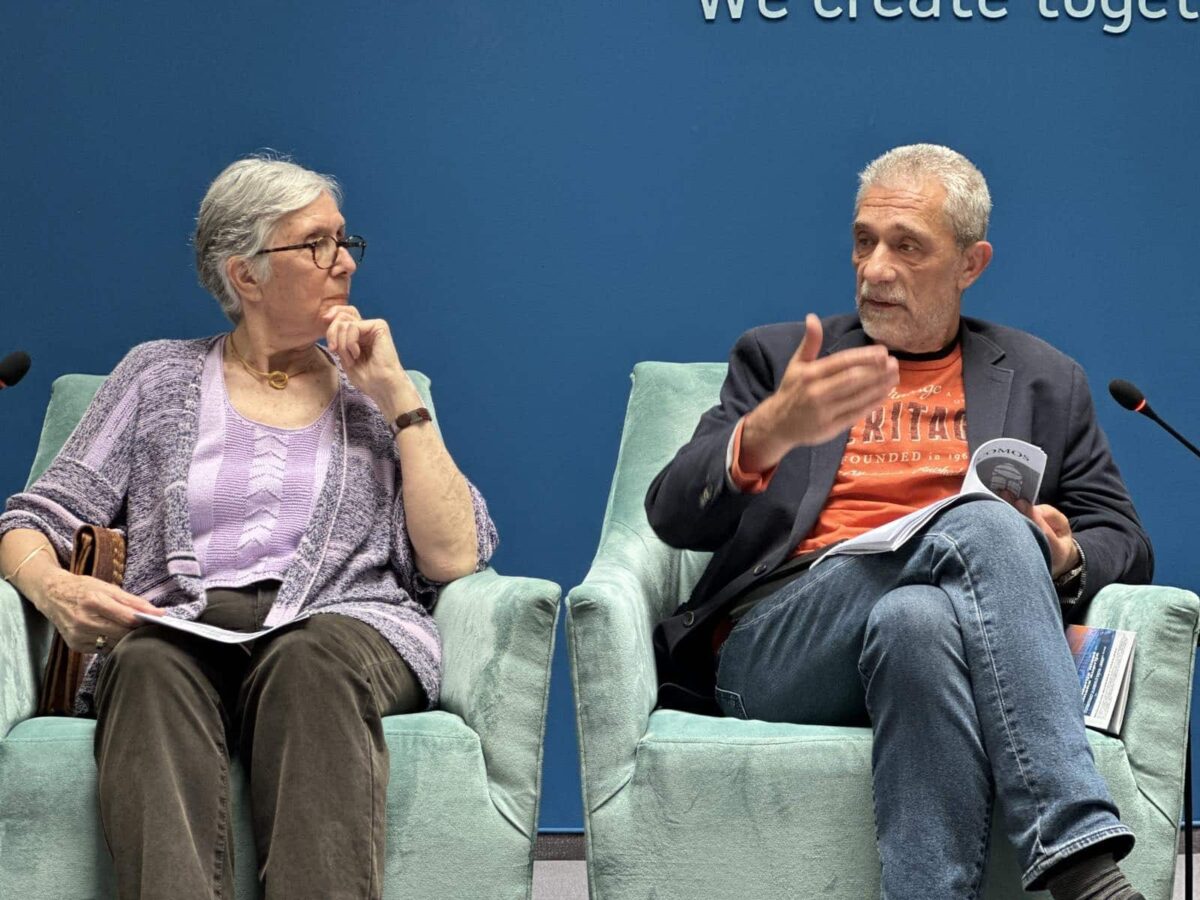
On Tuesday, 28 May 2024, a panel discussion was held at Europa House in Sarajevo, organised by the Federal Ministry of Culture and Sport / Institute for the Protection of Monuments and ICOMOS BiH, to present the translation of the document “European Quality Principles for EU-funded Interventions with a Potential Impact on Cultural Heritage”, supported by UNESCO.
At the beginning, the moderator of the panel, Dr Elša Turkušić Jurić, B.Eng.Arch., introduced Prof. Dr Riin Alatalu, Vice-President of ICOMOS International, who greeted the gathering via an online platform and briefly discussed the need for, preparation and significance of this document.
The following participants took part in the panel discussion:
- Prof. Dr Vjekoslava Sanković Simčić, National Committee of ICOMOS in BiH;
- Prof. Dr Robert Stergar, B.Eng.Arch., Director of the Institute for the Protection of Monuments within the Federal Ministry of Culture and Sport;
- Prof. Dr Edin Bujak, Department of Archaeology, Faculty of Philosophy in Sarajevo;
- MA Sanja Zagorac-Jozić, Municipality of Ilijaš;
- Prof. Dr Milijana Okilj, Republic Institute for the Protection of the Cultural and Historical and Natural Heritage of Republika Srpska (online platform);
- Prof. Dr Nermina Mujezinović, National Committee of ICOMOS in BiH (online platform);
- Marela Kurtuma, Tourist Organisation of the Municipality of Vlasenica (online platform);
- Aida Murtić, B.Eng.Arch., BiH coordinator for the preparation of the document;
- Gianluca Vannini, guest participant, Delegation of the European Union to Bosnia and Herzegovina.
The participants emphasised the importance of this document and particularly highlighted the significance of the translation, which should facilitate the process from decision-making, planning, design and implementation through to the management and maintenance of cultural and historical heritage assets. Particular emphasis was placed on the importance of the document for the authorities of local communities, which should make the best possible use of natural and human potential and spatial resources in order to avoid negative impacts on cultural heritage.
The document contains 40 recommendations and 7 criteria that should be applied during the implementation of projects that may have a direct or indirect impact on cultural heritage.
The participants agreed that the document is not binding, is difficult to implement fully under the regulations currently in force and, regardless of the fact that it is intended for projects financed from EU sources, the recommendations and criteria should be followed to the greatest extent possible.
Following the discussion, an architectural walk was organised with the participants and guests in attendance, entitled “Architecture in My Neighbourhood – Sarajevo Modernism (1918–1940)”, a project supported by the Federal Ministry of Culture and Sport and led by Dr Elša Turkušić Jurić.


