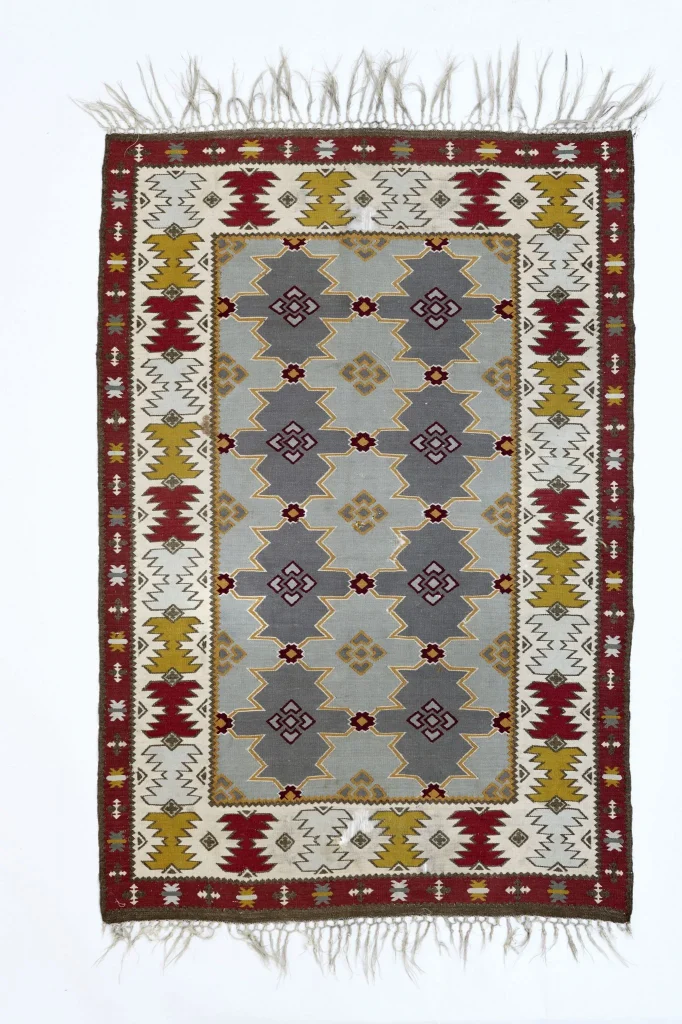
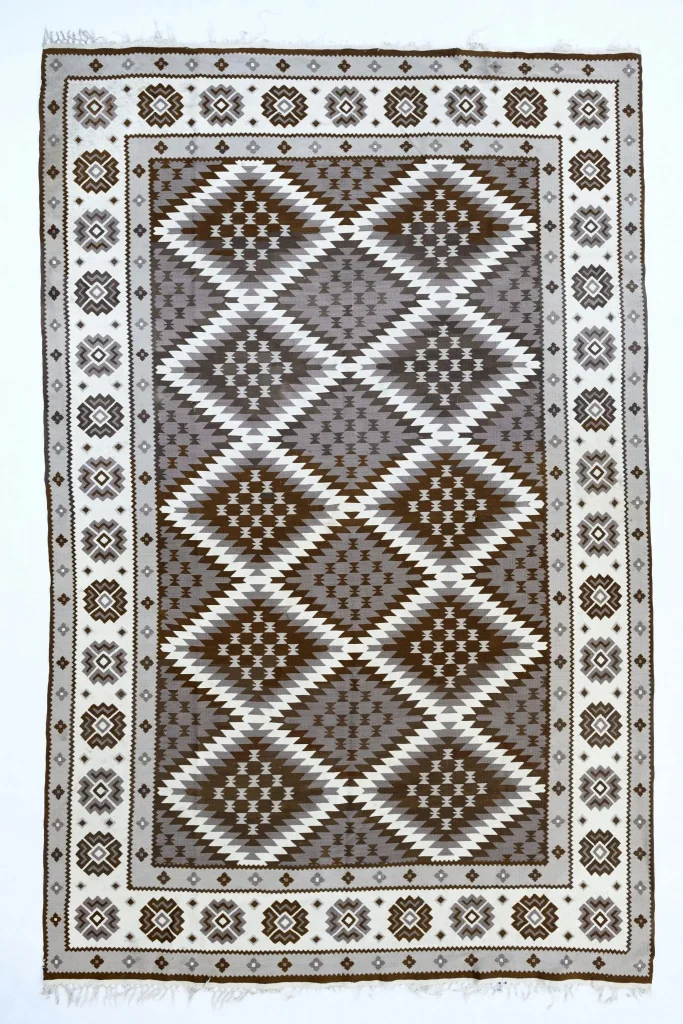
The Bosnian rug represents one of the most authentic forms of material and spiritual creativity in Bosnia and Herzegovina. As a textile form that combines functional, aesthetic and symbolic dimensions, it was not merely an object of everyday use, but also a bearer of collective memory, family identity and the cultural continuity of the community. Over the centuries, it was an integral part of the home – covering floors, divans, beds and tables, serving as a curtain and wall decoration, and constituting an important part of a young woman’s trousseau.
The historical development of the Bosnian rug is associated with textile techniques present in this area since the Neolithic period. A particularly significant chapter in the history of the Bosnian rug is linked to the establishment and operation of the Tkaonica ćilima carpet-weaving workshop in Sarajevo during the Austro-Hungarian period. Organised hand production of Bosnian rugs ceased in 1971, bringing to an end an important industrial chapter in the history of this tradition.
The basic technique used to make Bosnian rugs is the klečanje technique, flat weaving without knots, which requires precision, long-term work and a deep knowledge of ornamental composition. Knowledge was traditionally transmitted orally, within the family and local community, thereby making the weaving process an act of preserving identity. Today, this practice is maintained through the work of associations, museum workshops, educational institutions and family lines of knowledge transmission in Travnik, Tuzla, Visoko, Kakanj, Sarajevo and other communities.